British solar panels: what to buy, who makes them, and who should fit them
Very few solar panels are made in Britain, and most homes don’t need them to be. This guide shows you what a “British” label really means, how to compare the panels on your quotes by their datasheets, and how to find and check an MCS-certified installer near you.
Most panels on British roofs are imported. Here is what that means for you
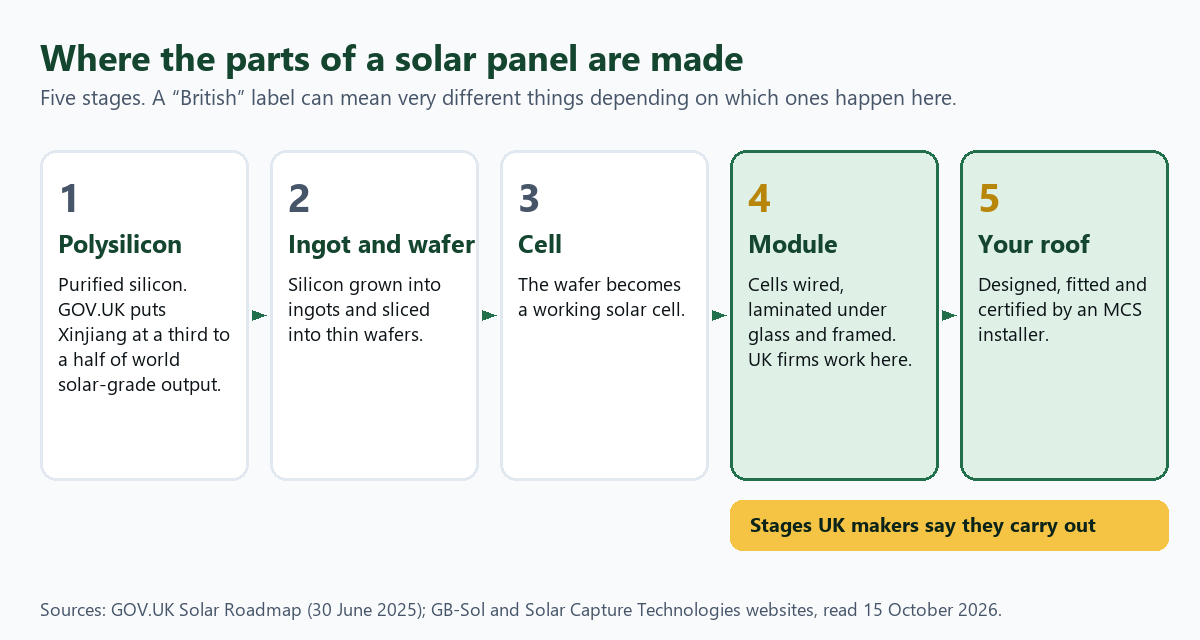
A solar panel is made in five stages: purified polysilicon, ingots sliced into wafers, solar cells, the module (cells wired and laminated under glass), and finally your roof. The government’s Solar Roadmap says Xinjiang produces between a third and one half of the world’s solar-grade polysilicon, and that the UK is unlikely to be able to compete in the existing global market for conventional solar panels.
The UK firms we found work at the module and roof-product end. GB-Sol makes pv slate (solar slates), infinity edge-to-edge solar roofs and integrated solar panels on the Treforest Industrial Estate, north of Cardiff, Wales. Solar Capture Technologies says it designs, assembles and quality-checks modules and roof tiles in Blyth, Northumberland. So a “made in Britain” panel is real, but niche, and mostly suits integrated or slate roofs rather than a standard bolt-on array.
If buying British matters to you for jobs, transport miles or supply-chain ethics, read British-made solar panels for what each firm makes and what it says about itself, and supply chains and forced labour for what you can actually check.
Four numbers that separate one panel from another
Advertising talks about “tier 1” and “premium”. Datasheets give you numbers you can compare. These four, read from the datasheet for the exact model on your quote, tell you most of what matters for a UK roof.
| On the datasheet | What it tells you | Why it matters in the UK |
|---|---|---|
| Module efficiency (%) | How much of the sunlight hitting the panel becomes electricity. | Higher efficiency means more output from a small or awkward roof. On a big south roof it matters less than price. |
| Temperature coefficient (%/°C) | How much output falls for each degree the cells run above 25°C. | Smaller numbers are better. Panels run hot in summer even in Britain. |
| Output promised at year 25 or 30 | The minimum share of rated power the maker guarantees later on. | This is your long-term yield. It is also what a warranty claim is measured against. |
| Product warranty (years) | Cover for manufacturing defects in the panel itself. | Terms vary widely, from about 15 to 30 years, and some depend on the installer registering the system. |
Our best solar panels UK page puts three premium panels side by side on these numbers, from their own datasheets. Panel technology names (TOPCon, heterojunction, back-contact) are explained in solar panel types.
What a typical home system looks like
Energy Saving Trust figures, read 15 October 2026. Your own quote will differ with roof, access and equipment.
Think of the system as an asset on your roof, not a monthly bill
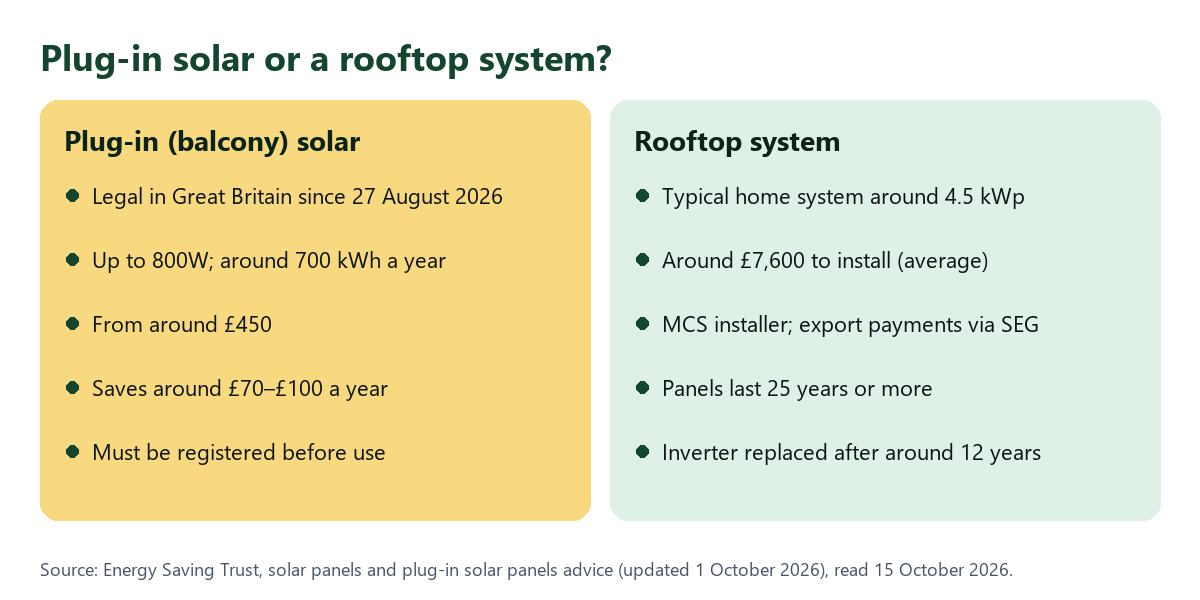
Paying for solar is buying a small power station you own outright. It produces for 25 years or more, according to the Energy Saving Trust, with the inverter usually replaced after around 12 years. Every unit you use yourself is a unit you don’t buy from your supplier, which is why solar suits households that use power during the day, or that add a battery to shift it into the evening.
What you don’t use can be sold through the Smart Export Guarantee. In Great Britain each supplier sets its own rate, seg tariff rates must always be above zero, and you can export to a different company from the one you buy from. The Energy Saving Trust puts a typical export payment at around 12p a unit, against more than twice that to buy a unit, so self-use is worth more than export.
A real date, not a sales line: installing solar panels on a home is zero-rated for VAT from 1 May 2023 to 31 March 2027 under VAT Notice 708/6. From 1 April 2027 the rate is due to return to 5%. Our VAT guide explains what qualifies.
Five steps from first quote to first export payment
The order matters: compare panels and check the installer before you pay any deposit.
- 01
Check your roof and your bills
Note your roof’s direction, any shading, and your yearly electricity use from a bill. These three things decide the system size more than anything else.
- 02
Get three or more MCS quotes
The Energy Saving Trust advises getting quotes from at least three MCS-certified installers. Each quote should name the exact panel and inverter models.
- 03
Compare datasheets, not adverts
Read the datasheet for each named panel: efficiency, temperature coefficient, the output promised at year 25 or 30, and the product warranty term.
- 04
Check the installer
Search the firm on the MCS register, confirm its consumer code (RECC or HIES), and ask how your deposit is protected before you pay.
- 05
Install, register, export
Your installer notifies the network operator and issues the MCS certificate. Use it to sign up for a Smart Export Guarantee tariff.
Plug-in solar is now legal in Great Britain
Since 27 August 2026, plug-in solar panels that meet the required standards can be used in Great Britain. They are limited to 800W, generate around 700 kWh a year, cost around £450 and could save £70 to £100 a year, according to the Energy Saving Trust. You must register a plug-in device before you use it. They are not a replacement for a rooftop system, but they suit renters and flats where a roof system is not possible.
What actually protects you when you buy solar
We hold no accreditation ourselves; we are a guide. These are the protections to look for in the installer you choose, and how to check each one yourself.
- MCS certification. Search the firm on the MCS register. Suppliers normally need an MCS certificate before they pay you for export, and the VAT relief on home installations (zero-rated until 31 March 2027) needs an installer who both supplies and installs.
- A consumer code. RECC or HIES membership brings rules on contracts, deposits and complaints. Look the firm up in the code’s own directory, not on its website.
- An insurance-backed warranty. It covers the workmanship guarantee if the installer has ceased trading. It is not a “fix anything forever” policy.
- An itemised written quote. It should name panel and inverter models, show a generation estimate for your roof, and set out the deposit and payment stages.
- No obligation. Sending an enquiry through this site costs nothing and commits you to nothing.
The full check takes ten minutes: how to check an MCS installer, then the quotes checklist. For what each warranty covers, see solar panel warranties.
Four things people assume about solar in Britain
“It isn’t sunny enough here.”
Panels work on daylight, not heat, and the Energy Saving Trust says areas further south get more direct sunlight, so yields vary across the UK rather than vanishing in the north. The honest test is a generation estimate for your own roof, which an MCS installer must give you.
“British-made panels are always better.”
Not necessarily. A UK-assembled panel can still use imported cells, and an imported panel can outperform it on the datasheet. Buy British if it matters to you; judge performance by the datasheet.
“I need planning permission.”
Usually not in England, if the panels stay within the permitted development limits. Listed buildings and some conservation-area walls are the main exceptions. See planning permission.
“Export payments make it pay.”
Mostly it is the electricity you use yourself that pays. Export is a bonus, at a rate each supplier sets and can change.
British solar panels: common questions
Are any solar panels actually made in Britain?
A few. GB-Sol makes solar slates, edge-to-edge solar roofs and integrated panels at a factory on the Treforest Industrial Estate north of Cardiff, and Solar Capture Technologies says it designs, assembles and quality-checks modules and solar roof tiles in Blyth, Northumberland. Neither says its solar cells are made in the UK. The government’s own Solar Roadmap (30 June 2025) says the UK is unlikely to be able to compete in the existing global market for conventional solar panels, so most panels fitted to British homes are imported.
What is the best make of solar panel for a UK home?
There is no single best make. Compare the exact model on your quote by its datasheet: efficiency (how much roof area you need), temperature coefficient (how much output it loses when hot), the output it promises at year 25 or 30, and how long the product warranty runs. Then weigh the installer’s workmanship warranty, which matters as much as the panel.
How much does a typical home solar system cost?
The Energy Saving Trust puts a typical home system at about 4.5 kWp costing around £7,600 to install (read 15 October 2026). Your price depends on the roof, access, the panels chosen and whether you add a battery. Installation by an MCS installer on a home is currently zero-rated for VAT until 31 March 2027.
Do I need planning permission for solar panels?
In England most rooftop systems on houses are permitted development, provided the panels stay within set limits: on a pitched roof they must not protrude more than 0.2 metres or sit above the highest part of the roof. Listed buildings, and some walls facing a road in conservation areas, need permission. Wales, Scotland and Northern Ireland have their own rules. See our planning guide.
Can I get paid for the electricity I don’t use?
Yes, through the Smart Export Guarantee in Great Britain. Each supplier sets its own export rate, rates must always be above zero, and your SEG licensee does not need to be the same company as your current energy supplier. Suppliers normally ask for an MCS certificate. The Energy Saving Trust says export typically pays around 12p a unit, so using your own solar power is usually worth more than selling it.
Is this site an installer or a manufacturer?
Neither. British Solar Panels is an independent guide published by SEO-DONS LTD (company 16766013). We do not make, sell or fit panels. If you send an enquiry, it comes to us and we reply by email.
Roof tiles, slates and in-roof panels
If you are re-roofing, or live somewhere a bolt-on array would look out of place, integrated solar replaces part of the roof covering instead of sitting on top of it. This is also where most British-made products sit. Read solar roof tiles and slates, then the British-made vs imported comparison. New to the jargon? Try the glossary or browse all FAQs, and see inverters and maintenance for the parts people forget.
Ask us about your solar quote
Tell us a little about your home and what you are weighing up. Your enquiry comes to SEO-DONS LTD, the publisher of this guide, and we reply by email. We are not an installer and we do not sell or fit anything. If you already have a quote, tell us the panel and inverter models on it.
What happens next
- We read your enquiry.
- We reply by email, usually with the next step for your situation.
- You decide what to do next, with no obligation.